




Life’s success begins long before a child walks into their first classroom. From birth to age 5, children’s earliest experiences are the foundation for learning, well-being, and long-term opportunities. Kindergarten readiness shows whether young children have the environment, support, and opportunities they need to thrive in kindergarten.
One of the of the Flint Center for Educational Excellence’s six initiatives is the Flint Early Childhood Collaborative, whose focus is creating an education environment that provides those supports and opportunities that Flint’s youngest children and their families need to prepare them for kindergarten and beyond.
It includes the Charles Stewart Mott Foundation, Community Foundation of Greater Flint, Flint Center for Educational Excellence, Flint Community Schools, and the Genesee Intermediate School District.
When children start school ready to learn, they are more likely to read on grade level, succeed academically, graduate from high school and reach long-term economic mobility. Readiness is influenced by a broad set of early conditions that build on each other throughout early childhood.
According to the Office of Head Start, kindergarten readiness includes five key developmental domains: language and literacy, cognition, approaches to learning, physical development, and social-emotional development. These skills are shaped by a broad set of early experiences and conditions.
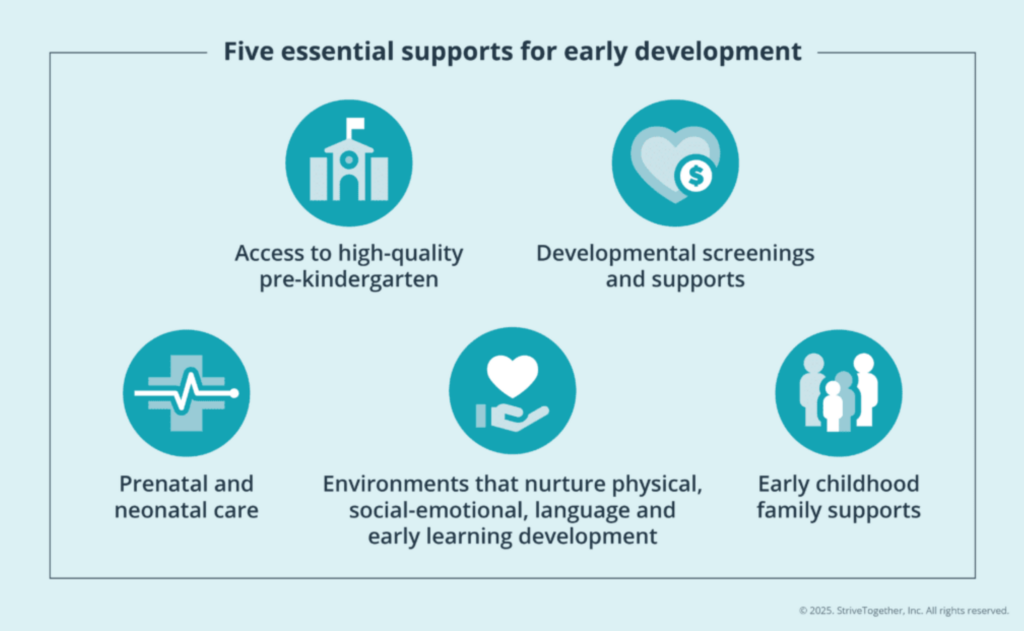
Research and practice consistently point to five essential supports for children’s early development:
- Prenatal and neonatal care
- Developmental screenings and supports
- Access to high-quality pre-kindergarten
- Early childhood family supports
- Environments that nurture physical, social-emotional, language and early learning development
These elements work together to create the conditions children need to grow, explore, and learn. When families have access to stable housing, nutritious food, safe neighborhoods, and high-quality early learning, children are more likely to meet developmental benchmarks by entering kindergarten.
Within this broader set of supports, high-quality pre-kindergarten emerges as one of the most well-researched and effective levers communities can invest in. It strengthens early learning outcomes on its own and amplifies the impact of family and community supports.
The Flint Early Childhood Collaborative, through the Flint Educare school and Cummings Great Expectations, is invested in providing a high-quality learning environment that address the five key developmental domains and serve as hubs for intensive family engagement. Our two-generational approach addresses and supports the critical link between the well-being of parents and the social, academic, emotional, physical, and cognitive development of their children, so that all kids can succeed from cradle to career.
The Collaborative is also focused on Enhanced professional development to help early childhood educators continuously enhance their teaching practices, skills, and the quality of their classrooms.
Because we know that the influence of early experiences becomes clear in national student outcomes by fourth grade, we work to align efforts within and between the Flint early childhood and elementary education sectors to create a seamless and connected early childhood system from birth to third grade, demonstrating the value of increased investments in early childhood to parents, policy makers, community stakeholders, philanthropic organizations, and the K-12 system.
 Underpinning all of this is our commitment to research and advocacy. Our partners collaborate with researchers, families, schools, and system leaders to advocate for research-backed and evidence-based policy changes that support Flint kids and their families’ needs and ensure access to early education for all.
In the long run, high-quality preschool is not just good for children and families; it also delivers strong returns for communities. High-quality early childhood education can generate at least $3 to $4 in long-term benefits for every dollar invested, while increasing property values and supporting greater family stability, according to a benefit-cost analysis in The Economic Returns to Early Childhood Education.
A national economic analysis found that property values rise in communities that support strong pre-k systems, and families experience greater stability. Universal preschool can yield more than $15,000 in economic benefit per child to the broader economy, reflecting long-term gains, from higher earnings and lower public spending.
The Flint Early Childhood Collaborative is committed to working together to build a sustainable, equitable, early childhood system that allows Flint kids, their families, and the community to thrive.